
Yi Yi, by Edward Yang
Reconciliation and centering, one step at a time

For most, the holidays are about family. Gathering with loved ones, reminiscing on stories old and new, and sharing the palpable effervescence that can only come from the clan you were born into. Traditions are repeated, reformed, and closeted altogether as families grow and change over time, but for many families there is a clear, unmistakable center. An intense pull, keeping every member within arm’s reach of the gravity that feels like no other bond. This year, my center shifted - my mother relocated from the town I grew up, went to school in, and called my home, moving seven-hundred miles away to a place I can barely picture. My family is far from large relative to many 21st century Americans, but our system has gotten wider over the last few years as both of my siblings have made similar moves to opposite sides of the country. I always saw myself as the pioneer of our small, four-person operation, forging new claims in distant states throughout college and post-graduation, but now I find myself the closest to our now abandoned home-base - a strange, empty feeling. This holiday season has given me a reason to reflect on these ideas, dealing with the speed at which life can change and, more specifically, the center of the family.
For me, there is no better film to digest these topics than Edward Yang’s Yi Yi. While much of my appreciation for Yang is devoted to his mastery of visual metaphor, I want to use Yi Yi to instead delve into narrative, specifically one about family. There is a clear, familial system at the center (and edges) of the film, held together through tightly-knit links that only become visible in times of togetherness - gatherings, funerals, and, relevantly, holidays. This is a remarkably broad film in many ways, and I find a lot of personal connection to much of the film, but I think the true value is in how that connection shifts. New messages appear in the sand as the winds of life blows new grains overtop old ones, and in Yi Yi these lessons shift and change long after the film’s conclusion. I will be discussing just three of the many characters in the film, but it goes without saying that my work here is only a small sliver of this film. I want to be careful to not gloss over the film at-large, and instead use the characters as singular pieces of a larger puzzle, taking the film’s English name as inspiration - “one by one”.
Kuiper Belt
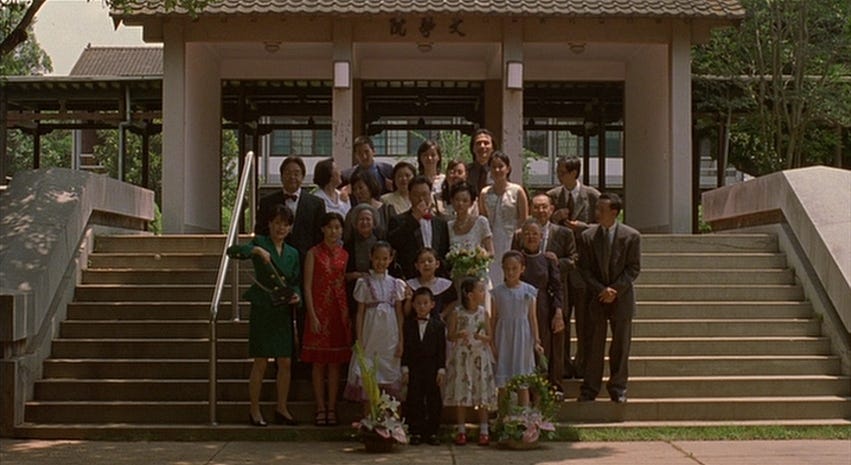
Yi Yi is a film that dances in and out of the lives of the Jian family, centering us on each key figure for just enough time to tell a story. We begin at the most congregative of familial congregations - a wedding. We see mothers and fathers, brothers and sisters, aunts, uncles, and more cousins than we can count, all orbiting around the gravitational pull of the Jian clan figurehead, ama, or grandma. As an aging woman, the toil of the festivities takes its toll on the eldest member of the family, and following the reception she suffers a stroke while taking out the trash. The incident is traumatic and dire for all members of the Jian family, who are faced with a new world of inertia, reflection, and self-discovery. Each and every character finds their own path in unique ways, and spend the final days of ama’s hospice stay consulting their comatose idol for guidance. Yi Yi is really a series of small, barely connected stories, rather than a long-form narrative, but the completeness of its coverage is not lost by the end. Each miniature act gives us new perspectives into the human life, covering everything from childhood to death, and painting an incredibly detailed swath of turn-of-the-century Taiwan.
The film’s lead, undeniably, is NJ (Wu Nien-jen). More than many other of the Jians, NJ lacks a centering point far before ama’s stroke, struggling to find satisfaction in his monotonous sales job. At the wedding, NJ runs into an ex-lover, Sherry (Su-Yun Ko), where they exchange phone numbers. Throughout the film, this relationship teeters on the edge of affair, as the pair meet up in Japan during one of NJ’s corporate client chase-downs, but never quite reaches a dramatic realization. For all of his curiosity of spontaneity, NJ refuses to cross the line, insisting on separate hotel rooms for him and Sherry in Tokyo. He is on the outside of the family, not related by blood to anyone we see (excluding his own children) in the film, and the distance is clear - if ama is the gravitational center of the Jian system, NJ orbits on a dangerously eccentric path. At times, it looks like the physical (and moral) pull is barely there, and we struggle to remember that a physical link is even there. The resulting feeling is not one of impulse, but one of slow, burning pain that is only really felt long after the story of the film.
NJ, in particular, as the patriarch and sole bread-winner of a remarkably middle-class family, is tasked with being the monolith, with being the unwavering icon of emotionless masculinity that bears the burden of the rest of the family struggle. At work, the story is the same, as he is required to spend late nights and early mornings out with clients, trying to win their favor in a constant performance. In NJ’s world, there is no center - family, work, and his own personal discovery all struggle to find a single binding agent. Rather than write a character in chaos, Yang chooses to keep NJ in the state in which we meet him - acceptance. What else can he do? It is his role in the family to be there for the others, and by the film’s conclusion he returns to this routine of apathetic play-acting. Somewhat interestingly, I think that NJ is the least important member of the family from a narrative sense in Yi Yi. As the furthest from the center, his story barely touches any other that we see, and the screen time that he shares with his wife and children is minimal at most. Much of the NJ scenes feel dream-like, colored with the bright neon of 1990s Taiwan and scored with the unbelievably beautiful piano serenades of Kaili Peng, Yang’s wife. This journey of self-realization for the Jian father is just that, a dream. Ideas of escape, the spontaneity of a single man, they are only things that can exist in the moment. NJ has responsibilities at home and at work, and he knows that. These moments we spend with him are surreal but almost tantalizing close to true drama, never quite resulting in collision. For many, this is real life - acceptance of what is, never quite touching what could be.
Black Gold
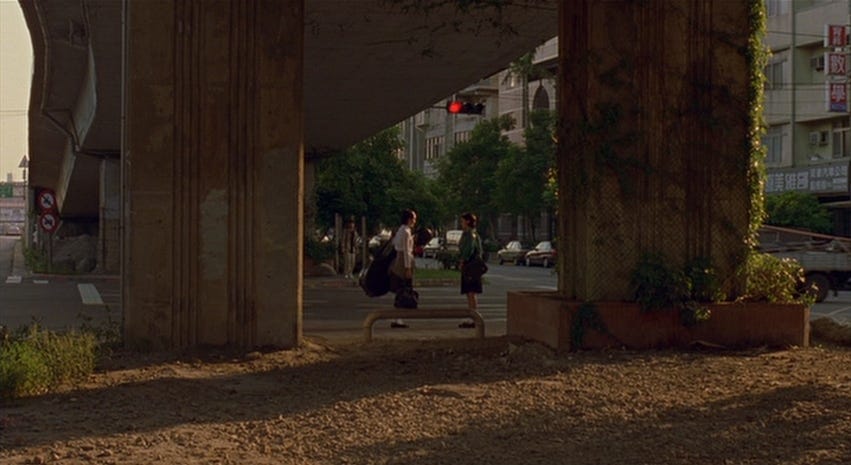
While NJ is off skirting the approaches of ex-lovers, we see small slices of life among the rest of the Jian family, bouncing between collages of reflection in the beauty of summer in Taipei. The first of these is with A-Di (Chen Hsi-Sheng), the recently married son of ama, and brother-in-law to NJ. In contrast to NJ’s firm moral compass, A-Di is an image of impulse. He is confident, brash, and above all, spontaneous. The newly-minted groom is kicked out of his home following a failed investment, and asks (of all people) his ex-girlfriend for money. He is allowed to return home following the birth of his child, but the tension reappears at the baby shower as this same ex-girlfriend makes a surprise appearance. A-Di, more than any other character, is Yang’s personification of Taiwan. I have discussed this type of screenwriting before with Yang’s Taipei Story, and it is a key feature of the Taiwanese New Wave of cinema.
While the uncertainty about the island’s future was palpable in 1985 for Yang’s previous work, the self-discovery had taken place by the time of Yi Yi. Martial law was in place in Taiwan for nearly forty years, being lifted in 1987 as the desire for democracy bubbled to an unstoppable fury. The first Taiwanese-born president took office in 1988, and promoted a heavy “Taiwan first” culture, embracing new, hasty ways of industrialization. His term had ended by 2000, but was tainted heavily with corruption, lack of foresight, and a strange sense of caring acceptance. A-Di, for me, is the same - he can’t seem to get a thing right, struggling to maintain his relationship with his new wife, yet he is still cherished by the Jians. Through failed investments, questionable (at best) marital practices, and a near-death experience in a self-caused gas leak, he remains confident, brash, and spontaneous. An inattentive father is still a father, a questionably ethical Taiwanese-born president is still a Taiwanese-born president, and a home with a gas leak is still a home. A-Di’s orbit, though shaky, remains as close as ever to the center - he is, after all, family.
No-Wake Zone
By far, my favorite story within Yi Yi is that of Yang-Yang (Jonathan Chang), the youngest member of the Jian family and son of NJ. The eight-year-old boy is just young enough to not quite understand his grandmother’s peril, but just old enough to take action about it. He tries to speak to his grandmother without success, and he, adorably, figures that her ears no longer work. To remedy the lost communication, Yang-Yang begins taking photographs using his father’s camera, capturing daily life so that he can continue to tell stories to his grandma in a new way. Beyond the obvious filmmaker/photography metaphor that appears again and again in Yang’s work, it is a fascinating look at how someone born into the circle reconciles with his place within it. Yang-Yang has no understanding of what he could or will become, and is focused solely on the present, a mindset that only he seems to portray amidst the chaos of ama’s impending death.
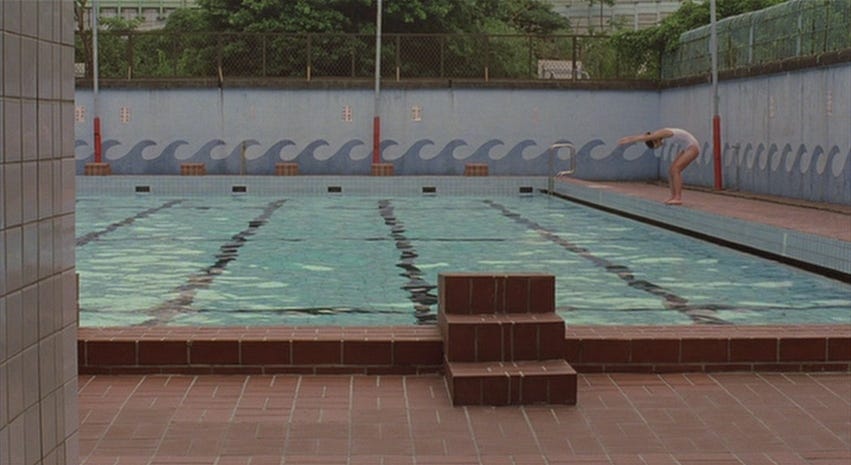
While most of the stories of the rest of the family touch on similar themes of family, maturity, and hypothetical futures, Yang-Yang’s narrative feels noticeably different. He spends much of the film in a state of permanent curiosity, following people around trying to get a sense for who, and how, they are. In one particularly endearing scene, he attempts to teach himself to swim; he is not learning for any practical reason, but rather, so he can better understand his grade school adversary slightly better. The young girl, who is clearly attracted to Yang-Yang, is seen swimming from afar, so Yang-Yang decides the only way to learn about her is by mimicking her behavior. This young journey of self-discovery is so fascinating to me because it is clearly outside the bounds of his designated orbit - while all the other family members stay relatively in line with their predetermined role, Yang-Yang does not yet have one. Unlike his sister, who was partially raised by her grandmother, the young boy is not old enough to have nostalgic memories of the woman that held everything together, and is not emotionally tied down to a life of acceptance.
Beyond a narrative element (and the film’s poster), Yang-Yang’s photographs are the keystone to everything Yi Yi sets out to do. Capturing life in the moments that pass by too fast, documenting his own adolescence in ways that are far more mature than he can even realize, all in an effort that is far more simple than suggested - just to talk to his grandmother. At her funeral, Yang-Yang recites a monologue that comes off as far more practiced than anything from the rest of the family, and shares a wonderful story about his newborn cousin, telling his grandmother that he finally understands how it feels to be old (I empathize, Yang-Yang). His story is one of true self-discovery, for the first time, in a way that is simply not possible from any other perspective. Finding humor in grief, acceptance in sadness, and ingenuity in catastrophe, the way Yang conveys these messages through the eyes of a child is nothing if not perfect. It is deep, layered, and endlessly thought-provoking, and yet, it is simple. It is serene, slow-moving, and a reflection of life in ways that so many films fail to recreate. It is remarkable how impactful and momentous these small moments with Yang-Yang feel, holding onto every last breath as we watch a child practice diving, but it is because we miss it. We miss the times before the rush, before our lives began to be filled with routine, drama, and, perhaps most importantly, with stasis.
Silent Supernova
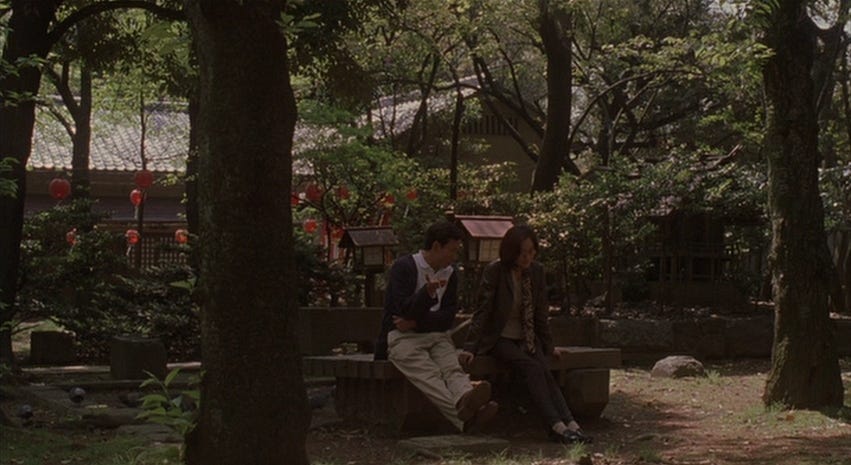
For many, Yi Yi is Edward Yang’s masterpiece. I love Taipei Story for its visual brilliance and deeply historical and cultural metaphors, but I tend to agree with the consensus that this film is, without a doubt, unmatched. There are so few films that can strike such different chords in different phases of life, giving new perspectives on old stories with each and every rewatch. The innocence of childhood, the excitement of growing up, the hardship of grief, and the deeper pain of the results after, this is what life is all about. Finding yourself, finding those around you, and learning that there is no singular, universal center - it moves, it shifts, sometimes within and often without, pulling and pushing us around into new roles. This film shows a family that is linked by a force beyond our sight, but gives the space necessary to show that each story, and each character, is their own, singular object.
When everything slows down, when NJ returns home from his pseudo-affair, and A-Di settles back into dangerously unstable married life, Yang-Yang shares his photos with his father, giving a confusing realization: they all look the same. Every photo, as expected from an eight-year-old boy, is skewed, crooked, and focused on the same subject - the back of people’s heads. When asked, Yang-Yang explains that he wanted to help people see the only thing that they can’t. It is an ending that is unbelievably marvelous, undeniably genius, and truly, truly profound. We fail, in times of crisis and times of stability, to realize the deep paths that we carve behind us. Actions and words impact every person we meet, in the same way that small approaches of celestial objects slightly effect the gravity of everything within the system. Always moving forward, worried about the next thing, never considering to look in the most obvious, but inaccessible place - right behind us.